No. 7
The Seven Dials MysteryNo. 7 is the elusive president of the Seven Dials Society, a leader whose absence from a secret meeting makes his authority more striking, not less. The members call him the person who brought them together, while the Russian warns that anyone who crosses him should be pitied. The mystery around his identity and methods turns the society’s unseen head into a source of both suspense and menace.
Identity and Introduction
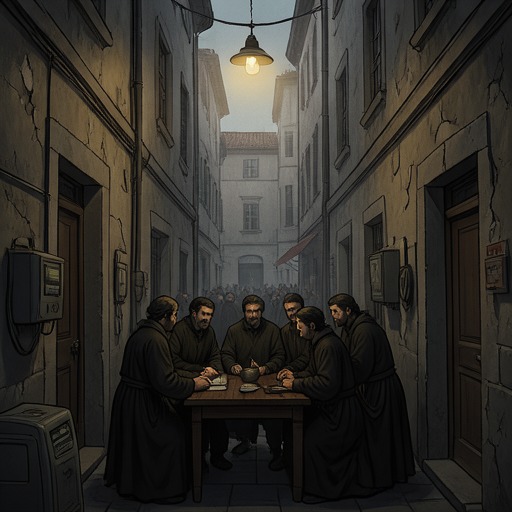
No. 7 is known by a number rather than a personal name. During the meeting Bundle secretly observes, the members look toward the empty chair at the head of the table and ask whether they will ever see their president. No. 5 describes him as the one who called the group into being; the Russian replies that No. 7 works in his own way. The exchange establishes a hierarchy whose most powerful figure is not present to explain himself.
The members’ uncertainty extends even to how they imagine him: No. 5 refers to the person who might confront him as a man or a woman. The evidence offers no physical description of No. 7 in this meeting. Instead, his character is built through other people’s words, and the gap between the empty chair and the confidence with which his authority is invoked becomes part of his presence.
Authority and the Society
The Russian’s account makes No. 7’s influence sound formidable. After warning that too much is becoming known about the society and its meeting place, he says that those who threaten it must be silenced. When No. 5 asks why the president is never seen, the Russian answers that No. 7 has his own methods, then adds that he pities anyone who comes up against him. The meeting supplies no example of No. 7 personally carrying out a threat; its force lies in the members’ acceptance of the warning and their deference to a leader who remains elsewhere.
The society’s business gives that authority practical stakes. Its members have plans for Wyvern Abbey and discuss a scheme concerning Eberhard’s invention, which an aviator at the meeting says depended on Eberhard’s genius to bring to fruition. Mosgorovsky says the original scheme needs no further discussion. The scene does not show No. 7 directing this particular conversation, but the members conduct it under the authority associated with his presidency.
The Founding Mystery and Its Context
The meeting’s questions about No. 7’s absence also attach him to a larger uncertainty: the members say he called the society into being, yet they do not explain who he is or how he operates. Their discussion of Chimneys is similarly unresolved; when asked whether anything has come to light there, the answer is no. The organization’s knowledge is therefore presented as partial even from within its own gathering, while the president’s unseen work is invoked as an explanation for why he need not appear.
The closing account by Superintendent Battle supplies the background to the group’s beginnings. Battle says that Mr. Wade first approached him with the idea of forming amateur workers for secret-service work; Battle warned that the undertaking could be dangerous, but Wade and his friends went ahead. He explains that they were pursuing a particularly dangerous thief, active in Mr. Wade’s world and interested in valuable international secrets. Two secret inventions had already been stolen by someone with inside knowledge, and professional investigators had failed before the amateurs took up the pursuit. This account gives the society’s origin a more concrete and less omnipotent character than the meeting’s talk of No. 7 suggests: its work began with a risky amateur undertaking and a specific investigative target.
Narrative Role
No. 7’s absence makes the society’s internal power structure a puzzle. The members’ questions invite the reader to treat the empty chair as evidence of a hidden identity, while the Russian’s calm assurances make that concealment seem deliberate rather than accidental. No. 7 thus functions both as a person within the organization and as a delayed answer to the novel’s questions about who directs its secret work.
The contrast between the meeting’s ominous language and Battle’s retrospective explanation also reshapes the meaning of the society. What sounds in the room like a tightly controlled organization threatening anyone who learns too much has roots in a band of young amateurs who accepted danger to pursue a serious criminal. No. 7’s significance lies in that tension between concealed authority and the improvised origins of the operation.